When the tones drop: A day inside the Midland Fire Department
From routine checks to urgent calls, a day with Midland firefighters uncovers the unseen work behind the sirens.
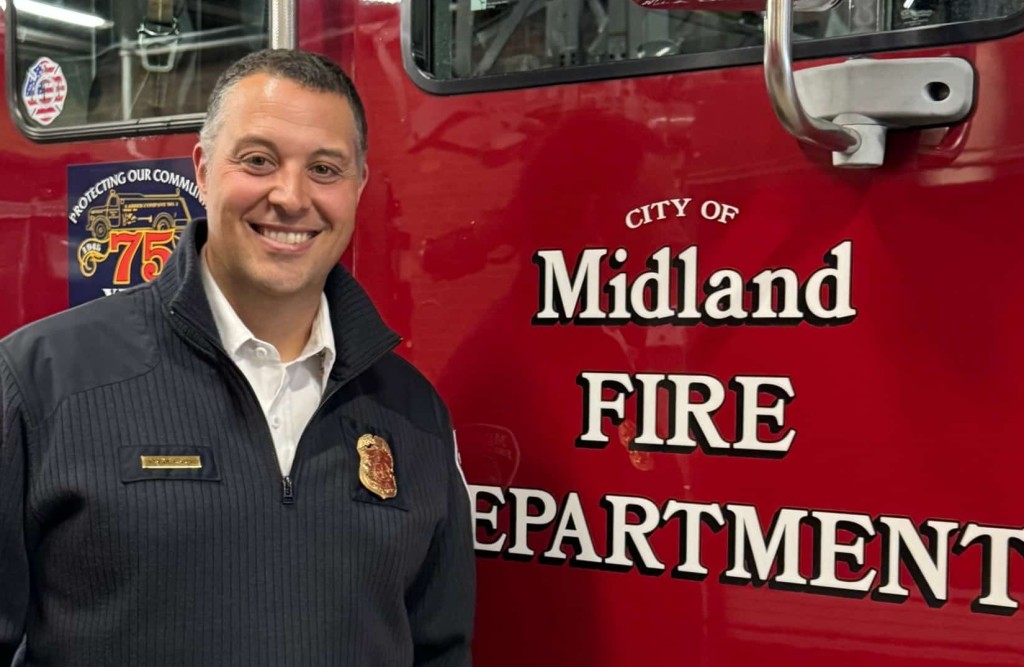
On Tuesday morning, I walked into the Midland Fire Department with a notebook in my hand and a quiet awareness that I was stepping into a world most of us only encounter on our worst days. Sirens, flashing lights, and turnout gear are familiar sights in Midland. But spending a full ride along inside the department, moving through the city with Battalion Chief Mark Laux, gave me a deeper understanding of what happens between the tones dropping and help arriving.
Laux met me early in the shift, already in motion. The day officially began at 7 a.m., and as he explained, there is no warm-up period. “We get here at seven o’clock, get our uniforms on, and we’re off and running from the word go,” he tells me. “The day just begins, and it’s full.”
That fullness is reflected in the department’s call volume. By the end of this year, the Midland Fire Department will have responded to more than 7,000 calls. Those calls span everything from fires to medical emergencies to lift assists and safety checks. It is a steady, unrelenting demand that shapes every shift and every decision.
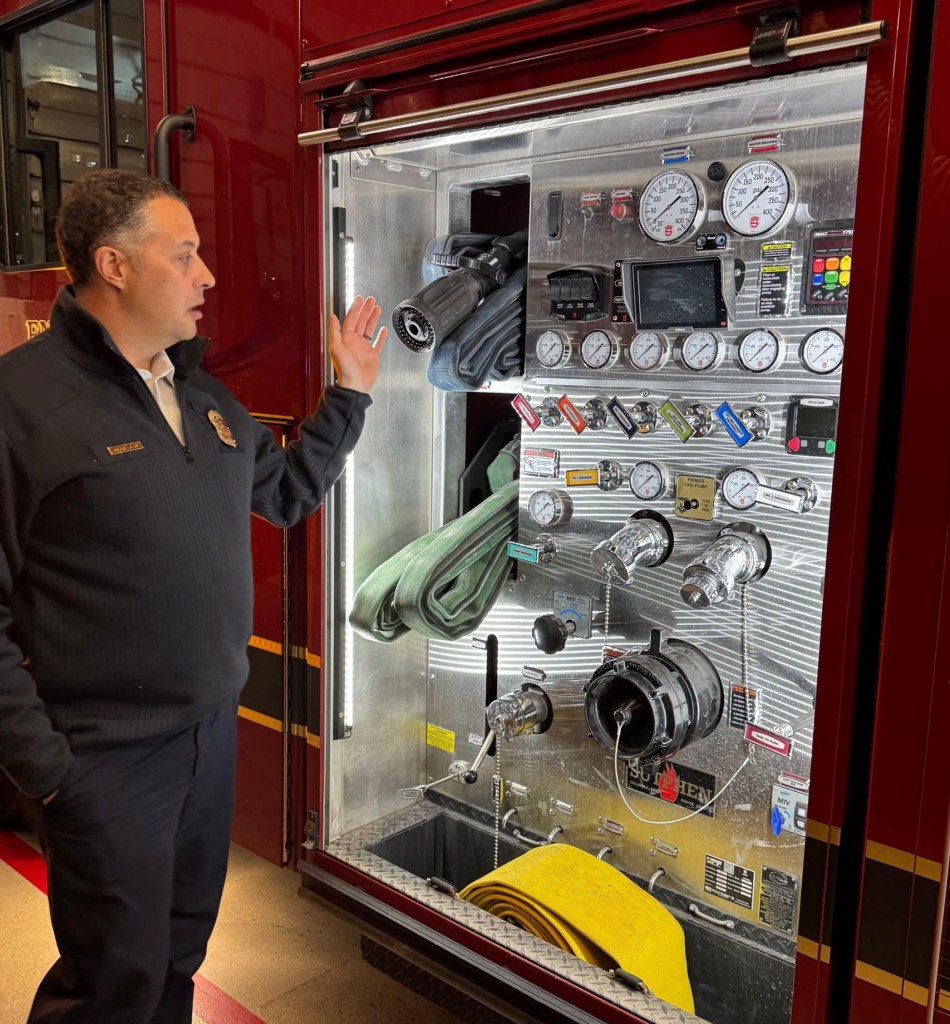
The Midland Fire Department operates on 24-hour shifts, divided into three platoons of 14 personnel total. Each platoon works from one morning to the next, covering the city through three fire stations. Every station is led by a lieutenant, who reports to the battalion chief on duty. The department is led by Fire Chief Joshua Mosher, who directs all operations and personnel under the guidance of City Manager Brad Kaye. Altogether, the department consists of 46 personnel, including command staff, firefighters, fire truck operators, a fire marshal, and support staff.
As a battalion chief, Laux oversees all three stations during his shift. He is responsible not only for emergency response, but for training, inspections, staffing, and ensuring crews and equipment are always ready. Even with a ride-along on his schedule, his day flowed with meetings, equipment checks, and conversations with firefighters moving in and out of the station.
Laux was promoted to battalion chief in December 2022, but his roots in the department run nearly two decades deep. He joined the Midland Fire Department as a firefighter in 2006, later advancing to fire truck operator and then lieutenant. He leads the department’s Technical Rescue Team, serves on the Michigan Region 3 Regional Response Team, and assisted with disaster rescue efforts during Hurricane Dorian through Michigan Task Force 1.
Before coming to Midland, he worked as a public safety educator, fire inspector, and fire investigator with the Saginaw Township Fire Department. He holds an associate’s degree in fire science from Delta College and was named the Carl and Esther Gerstacker Firefighter of the Year in 2013. He continues to work in Midland schools, educating children on fire safety through the Learn Not To Burn and Risk Watch programs.
Despite those credentials, what struck me most was how grounded he was in the everyday work. Throughout the morning, we moved between stations, checked in with crews, and prepared for whatever the day might bring. And then the tones dropped.
As we headed to calls, Laux explained what happens in those first critical minutes after dispatch. Notifications come through phones and radios. Crews move quickly but deliberately, listening, reading, and confirming routes. “When we’re driving, we’re not just driving,” he says. “We’re pre-gaming for what’s to come.”
Everyone plays a role. One firefighter navigates, another confirms information, and the driver focuses on the road. On unfamiliar streets, maps and tablets come out. Directions are called across the cab. The goal is simple: get there safely and as fast as possible.
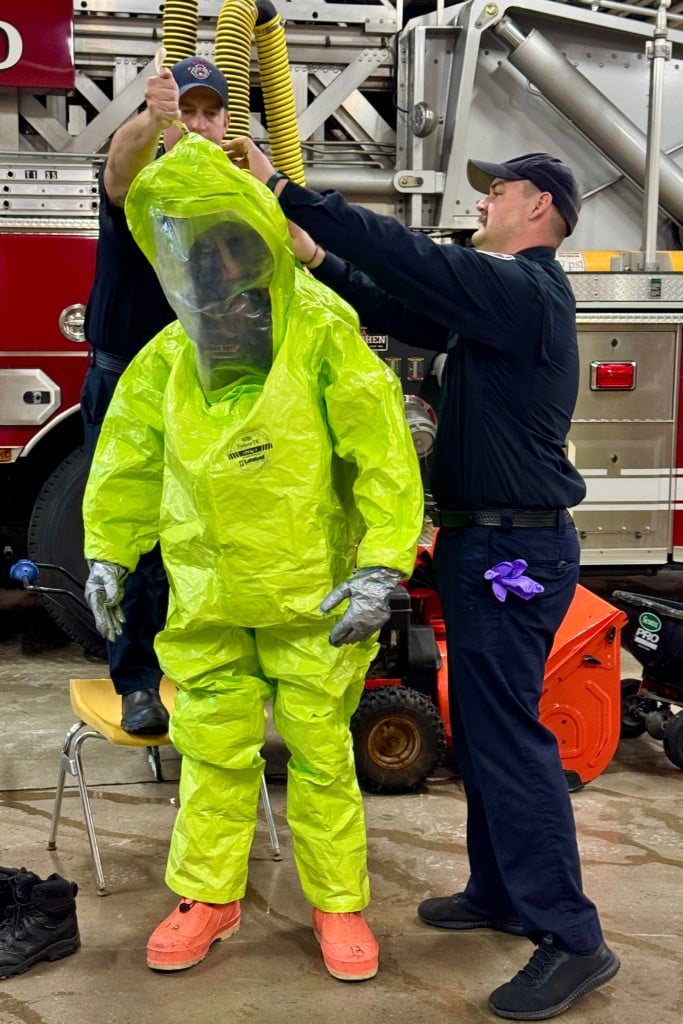
One of the biggest surprises for me that day was learning what the department responds to most often. Fires, while serious, are not the most common call. According to Laux, lift assists top the list. These are calls where someone has fallen and needs help getting back up, sometimes due to injury and sometimes due to mobility challenges. Medical calls follow closely behind, ranging from headaches and nosebleeds to breathing difficulties and chest pain. When you consider the large volume of calls that the department receives annually, it becomes clear just how often firefighters are stepping into people’s lives during vulnerable moments.
“It might not look like an emergency to someone on the outside,” Laux explains, “but it’s an emergency to the person who called it in. So, to us, it’s an emergency too.”
I saw that philosophy in action. On one call, multiple firefighters worked together to carefully lift a patient, using proper equipment and moving in sync to protect both the individual and themselves. No one rushed. No one worked alone. The teamwork was quiet, practiced, and deeply respectful.
Laux also addressed a question many residents ask: why does a fire truck respond alongside an ambulance on medical calls? The answer is timing. Fire crews often arrive several minutes before EMS, and those minutes matter. Firefighters can provide oxygen, take vitals, administer medication, and begin care immediately while waiting for transport units to arrive.
The emotional and mental preparation required for this work became more apparent as the day went on. Laux talked about the adrenaline that comes with every call, paired with constant mental checklists and planning. Physical fitness, healthy eating, and rest when possible are essential. Sleep during a 24-hour shift is unpredictable at best.
And yet, when the tones drop, everything else fades. “When that call comes in, all that goes out the window,” Laux says. “People are running to trucks to get to scenes to reduce problems as fast as possible.”
What the public does not often see, he explains, are the rapidly changing environments firefighters enter, including zero visibility, intense heat, and high stress, along with the calm required to function within them. Firefighters are not fearless, he says, but they are committed. They are problem solvers, trained to adapt and act with whatever information and tools they have in the moment.
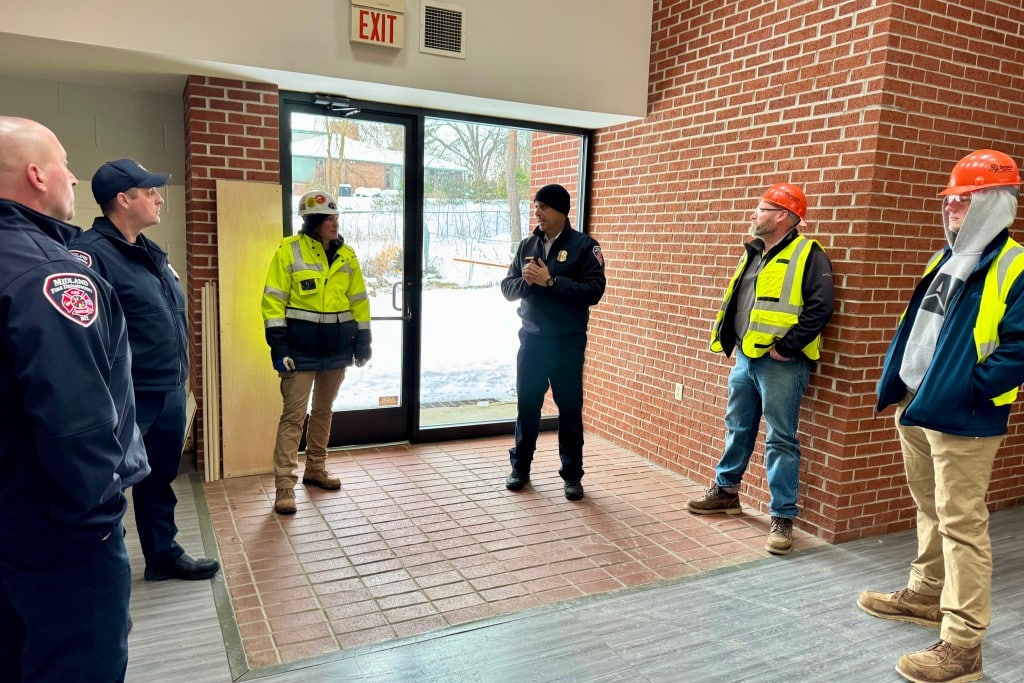
As the day wound down, I asked Laux what keeps him coming back, even on the hardest days. His answer was immediate and heartfelt. “It’s the people,” he shares. “This is a family environment. We laugh together, we train together, and we go out into the world to help people on their worst days.”
By the time my ride-along ended, the sun was down, and the station felt quieter, but only temporarily. Another shift would come in. Another day would begin at 7 a.m. And somewhere in Midland, someone would need help.
After spending the day inside the Midland Fire Department, I left with a deeper appreciation for the people behind the sirens. Responding to more than 7,000 calls a year is not just a statistic. It represents thousands of moments where someone needed help and a firefighter answered. The work is relentless, the stakes are high, and the commitment is unwavering. It is not just about fire. It is about service, teamwork, and showing up every time the call comes in.
Author

Related Articles
Library renovations bring innovation and family into focus
Despite renovations, services and programming continue at Grace A. Dow Memorial Library

Midland’s Service Club Alliance simplifies grantmaking to better support local nonprofits
Midland’s Service Club Alliance simplifies grantmaking by uniting service clubs through one shared application to better support local nonprofits.
City of Midland unveils draft of Parks and Recreation Master Plan for public review
Residents can explore the Midland’s Parks and Recreation Master draft and provide feedback through Jan. 9, 2026