Poseyville Preserve reclaims Midland riverfront
The Poseyville Preserve Project is turning the former Castle Concrete Block Plant site into a naturalized riverfront.
Tucked behind the East End development, just a short walk from downtown Midland, a long-overlooked stretch of land along the Tittabawassee River is getting a second life.
The Poseyville Preserve project is a collaboration between the City of Midland and the Midland Baseball Foundation. The initiative aims to turn a former industrial site into a public green space complete with nature trails, a pedestrian bridge, and fishing piers.
Located south of Founders Park and Dow Diamond, the site spans both sides of the Tittabawassee River, linking neighborhoods that have been historically divided by floodplains. Once complete, the preserve will offer a walkable loop that connects the Tridge to the East End.
Karen Murphy, Public Works Director for the City of Midland, and the city’s Project Manager for the Poseyville Preserve Project, says the project began with a 2014 FEMA flood mitigation grant. The city purchased the property in January 2016 and demolished the buildings.
“Once the city took the building down, we had about $360,000 less than that FEMA grant. We did a little bit of exploration on the site… when we found that the site had anywhere from three to 12 feet of concrete rubble. We were composing the soils there, and $360,000 was not going to be enough to even start any sort of renovation.”
The Michigan Baseball Foundation then offered to help. “They asked the city if we raised private funding through foundations and businesses and personal donations, would the city allow us to renovate the site into a naturalized park-type setting and then donate it to the city,” Murphy says.
The restoration is not just cosmetic. Native greenery planted by the Chippewa Nature Center has helped rebuild habitats and support local wildlife. With the environment in mind, the Preserve is intended to be an outdoor classroom, a place where residents of all ages can access, view, and learn about nature.
“The project will be literally a growing project for the next three or four to five years because a really key part of the project is we have partnered with the Chippewa Nature Center and they are doing all of the native planting installations for us,” Murphy says.
By mid‑2025, the walkway’s concrete deck was in place, and work was underway on lighting, boardwalks, and overlooks. The heavy structural work is expected to wrap up by the end of this construction season, with final planting and landscaping extending into next year.
Signs of life are already appearing as the site takes shape. Native wildlife like geese and deer have been spotted wandering through newly sprouting grass. As the City of Midland has shared, the Poseyville Preserve is meant to serve as a gateway into Midland, creating a space for renewal and environmental awareness.
“When you naturalize a site, it takes a while for the plants to really call it their home and to grow,” Murphy says.
Removing run-down structures and replacing them with natural systems is not just about aesthetics. The restoration helps mitigate flood risk, improve water quality, and soften the transition between Midland’s urban and natural zones.
Walking and bike paths will tie into existing trails, broadening access to public spaces and encouraging more time outdoors.
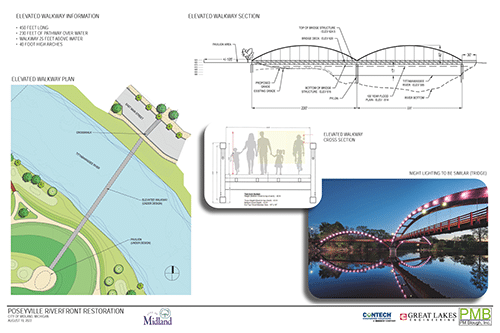
Murphy emphasized accessibility in the design. “The pedestrian walkway meets and exceeds ADA standards, so it’s a nice flat slope. Mobility devices, strollers, walkers, bikes — it’s very accessible for all,” she says. Benches will be placed every 200 feet along pathways, and LED lighting will illuminate the bridge.
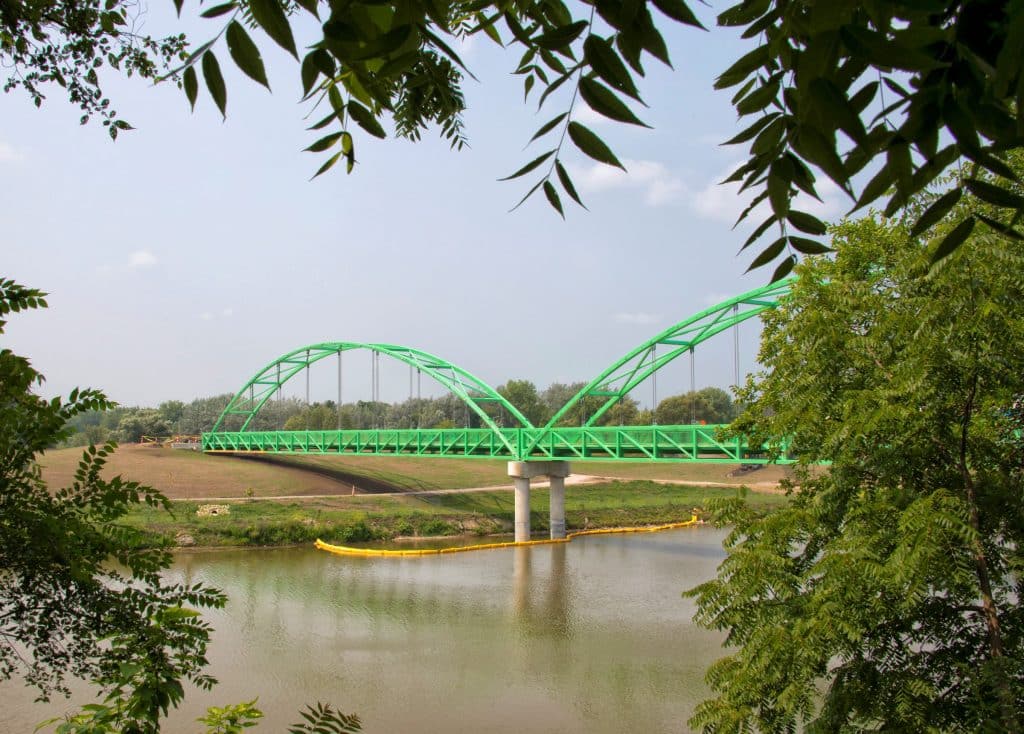
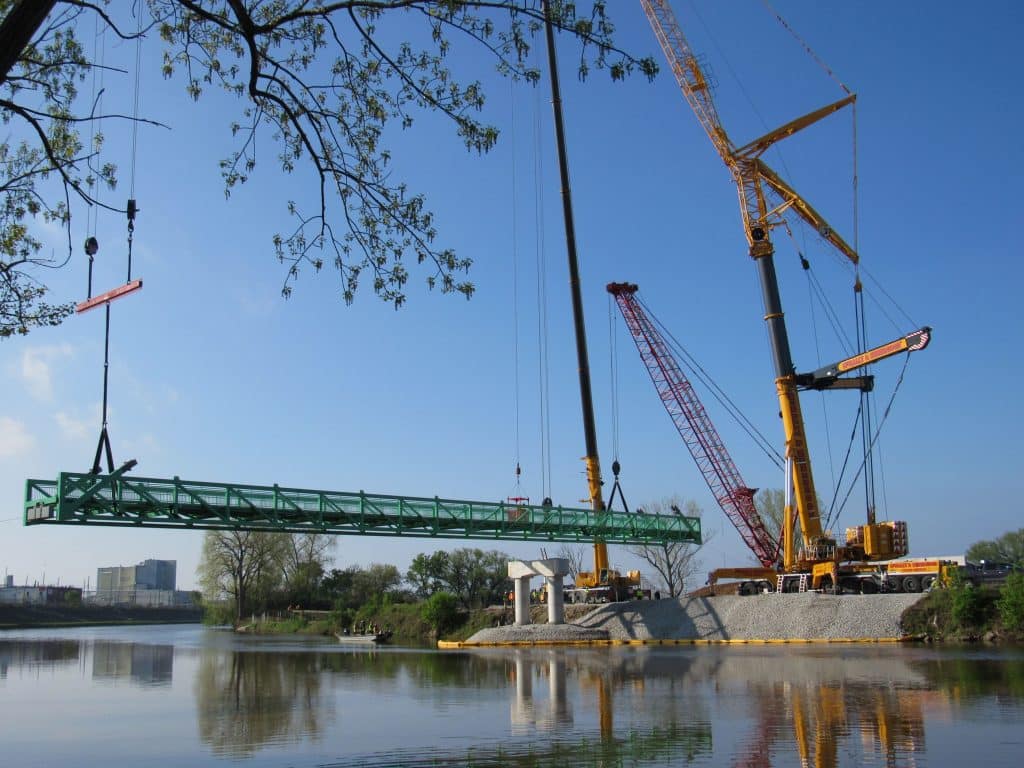
As of fall 2025, the bulk of the structural work is wrapping up. The pedestrian bridge spanning the Tittabawassee River is fully in place, with concrete decking poured and foundational supports in place. The work continues with the boardwalk and fishing piers in active development.
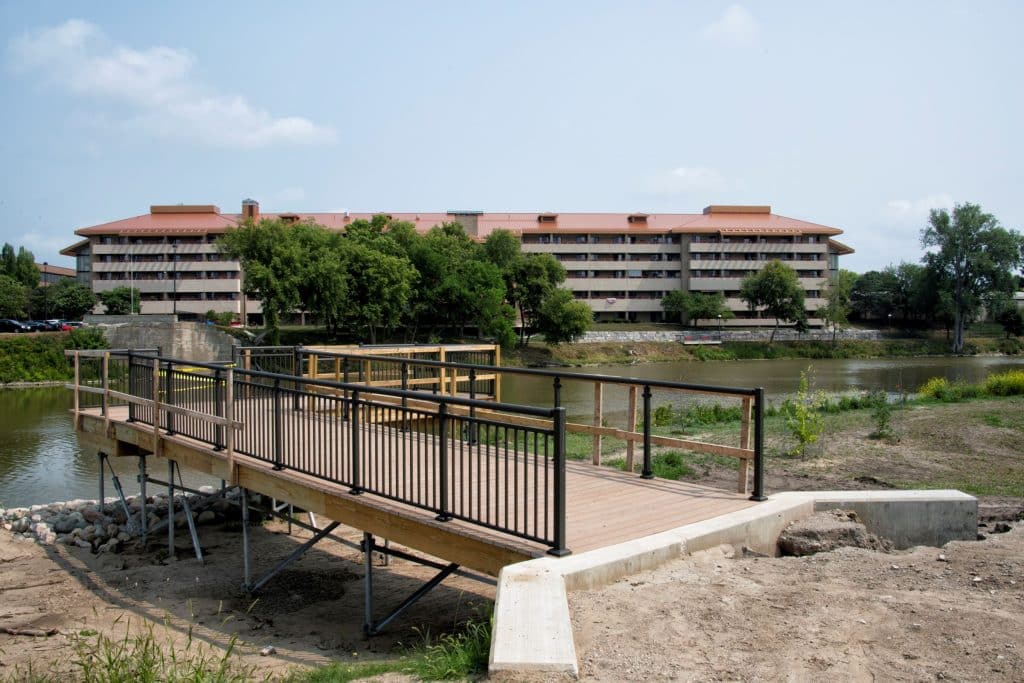
Crews have also begun grading the site to prepare for trail paving and accessible pathways. In some areas, wood decking is being added to create elevated walkways above floodplains, helping to protect native plants while allowing trails to stay open all year.
“As part of the project fundraising, there will be an endowed maintenance fund held at the Midland Area Community Foundation for any future maintenance that needs to be done,” Murphy says
Once the project is complete, residents will have access to a new public space that offers a fresh riverfront experience. Instead of being focused on large-scale events, the Poseyville Project is about building an everyday connection to the city.
Unlike the Tridge or the splash pad at Gerstacker Park, the Poseyville Preserve is designed for quiet use. Trails will be open to walkers, runners, and cyclists. Fishing piers and overlooks will offer spots to pause, and benches along the paths will provide accessible places to rest or watch the river.
Until construction is complete, access to the Poseyville Preserve remains limited. The west side of the site, between the river and Poseyville Road, is still closed to the public. Certain sections on the east bank near Founders Park are also fenced off during work hours.
The city is asking that residents do not attempt entry or send drones into the area. Construction equipment, excavation zones, and unstable trail surfaces can pose safety risks to pedestrians. In particular, the Poseyville Road bridge is not a safe place to stop or watch construction.
City officials have said updates will be posted regularly to the project’s website, and once the site is closer to opening, more information will be shared about ribbon-cutting events and public walk-throughs.
“When you’re coming from Poseyville Road from the south, that’s your first view of Midland,” Murphy says. “We wanted it to be something that people really saw and went, ‘Oh wow, look at that pavilion, and look at the contours of the land and all the pretty native plantings.’”
Plans to maintain the site include partnerships with organizations like the Chippewa Nature Center. The city hopes the preserve will continue to evolve in the years ahead, growing greener and becoming a staple in Midland.
If all goes according to plan, by the season’s end, the bones of the project will stand. By next spring, the plants and pathways will come alive, and a part of Midland that is often overlooked will be given a second life.
Author

Related Articles
Library renovations bring innovation and family into focus
Despite renovations, services and programming continue at Grace A. Dow Memorial Library

When the tones drop: A day inside the Midland Fire Department
From routine checks to urgent calls, a day with Midland firefighters uncovers the unseen work behind the sirens.

Midland’s Service Club Alliance simplifies grantmaking to better support local nonprofits
Midland’s Service Club Alliance simplifies grantmaking by uniting service clubs through one shared application to better support local nonprofits.