How Midland’s Great Start Collaborative nurtures children and strengthens community
Great Start Collaborative: Uniting families, educators, and community partners to ensure every child can thrive.
In the heart of Midland County, a quiet but powerful movement is shaping the earliest years of children’s lives and, in doing so, laying the foundation for stronger families and a more resilient community. It’s called the Great Start Collaborative, and though its work often happens behind the scenes, its impact touches nearly every family, educator, and early learning program in the region.
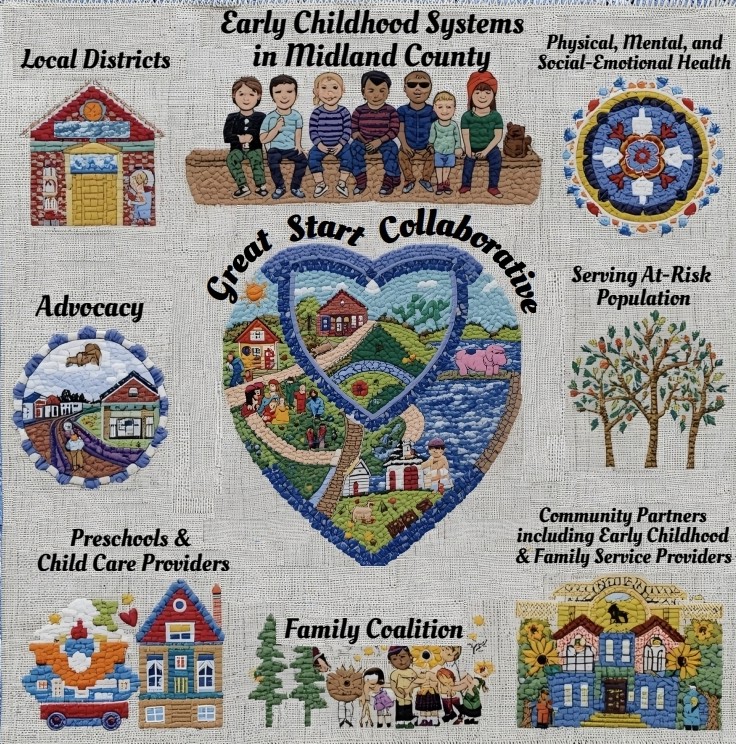
At its core, the Great Start Collaborative is more than a program; it’s a network of people who care deeply about children’s futures. From teachers and pediatricians to social workers and parents, the collaborative unites those who understand that the first years of life shape everything that follows.
“Early childcare and education impact everyone in our community,” says John Searles, Superintendent of Midland County Educational Service Agency. “We are able to reach and care for the most vulnerable while building families and really, building people.”
For Bethany Shoun, Director of the Great Start Collaborative for Midland County, leading this effort is about weaving together an “invisible tapestry of support” for local families. “I am responsible for convening meetings and workgroups, aligning our efforts with Michigan’s early childhood outcomes, and helping put plans into motion to address gaps in our local early childhood system,” she explains. “But the real power of the Great Start Collaborative lies in how we bring people together by removing silos and creating connections that help families thrive.”
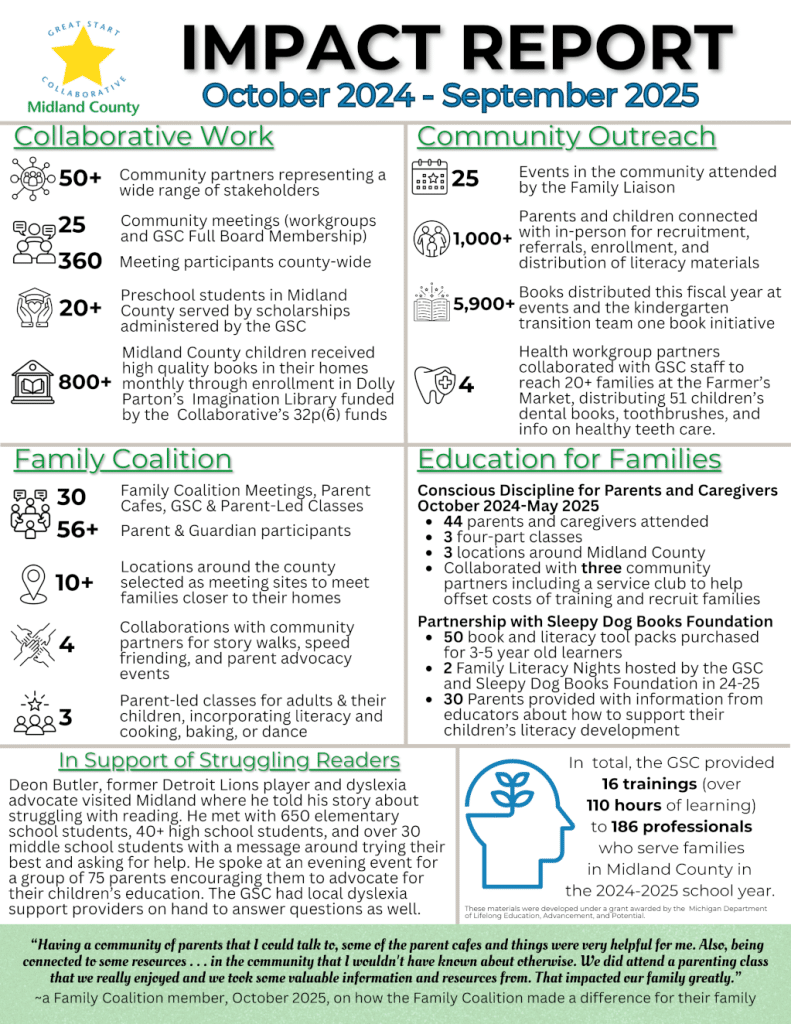
Community partnerships form the backbone of this work. The Great Start Collaborative works with health departments, local nonprofits, schools, and early education centers to make sure every child has the chance to start school healthy, supported, and ready to learn. Whether it offers dental education at the Farmer’s Market, organizes parent cafés, or provides preschool scholarships, its initiatives are designed to meet families where they are.
The preschool scholarship program, for example, provides tuition assistance to 20–30 children each year, giving families access to high-quality early learning environments that might otherwise be out of reach. Beyond financial help, these partner sites commit to exceeding licensing requirements through advanced staff training and program quality standards.
The Collaborative also offers professional development for early childhood educators; a crucial resource in a field where training can be expensive and hard to access. “When teachers and caregivers are equipped with knowledge about child development and behavior,” Shoun says, “it improves the quality of care and education children receive.”
While its leaders work on systems-level strategies, the heartbeat of the initiative lies with families themselves. That’s where Nikki Sprague, Midland County’s Family Liaison, comes in. “I lead and support the Great Start Family Coalition, helping parents use their strengths to plan and lead family-focused activities,” Sprague shares. “My goal is to connect families with resources and each other and to make sure no parent feels alone in this journey.”
One example of that work was a Speed Friending event, an idea borrowed from speed dating but reimagined to help parents build connections. “We provided dinner and childcare so parents could focus on making new friends,” Sprague says. “Every parent left that night with at least one new connection, and several of those friendships have lasted.”
Sprague also helps bridge the gap between families and decision-makers. Through her outreach, parents are now serving on local leadership teams, using their voices to shape the very systems that serve them. “That’s the power of the Collaborative,” she explains. “When parents feel seen, supported, and empowered, everyone benefits.”

Her work aligns perfectly with the vision outlined by the Michigan Department of Education, which defines Great Start Family Coalitions as groups of parents and caregivers who provide critical insight into how communities can better serve young children. These coalitions represent the diversity of their communities and play a vital role in guiding strategy, building awareness, and strengthening the bridge between families and institutions.
Michigan’s network of Great Start Collaboratives began nearly two decades ago with an ambitious vision: to ensure that every child, from birth to age eight, has a great start in life. Each Collaborative is tailored to its community’s unique needs and guided by four statewide outcomes: children are born healthy, children are thriving and developmentally on track, children enter school ready to succeed, and children are proficient readers by third grade.
Shoun explains that when state funding for the collaborative programs was eliminated, it felt like “the foundation thread was snipped from the tapestry” of early childhood education. “We are still doing the work in Midland for as long as possible,” she says, “with the hopes that our funding is reinstated, restored, or reimagined.”
Even with financial challenges, Midland’s programming continues to be deeply involved in statewide initiatives like Build Up/Help Me Grow, a coordinated referral system designed to connect families with early childhood services, and regional childcare coalitions working to address Michigan’s childcare crisis. Through a recent $1.6 million Child Care Wage Pilot grant, the coalition will be able to offer stipends to childcare workers, a small but meaningful step toward stabilizing an underpaid and essential workforce.
For Kim Michaud, Director of the Regional Preschool Partnership, collaboration is what sets Midland’s approach apart. “We work very closely with the Great Start Collaboratives in both Midland and Gratiot-Isabella to build and support the early childhood systems, prenatal to age eight, in all three counties,” she says. “Together we work to understand our community’s strengths and challenges and create a strategic plan to achieve positive outcomes for young children and their families.”
Michaud emphasized that investing in early childhood is not only about preparing children for kindergarten, but about building stronger, more resilient communities. “Investing in early childhood strengthens families, prepares children for school and life, and boosts children’s social skills, which leads to increased prosperity,” she shares. “It creates a more skilled workforce and increases the community’s economic stability. Ultimately, the investment in early childhood yields a more educated, healthier, and productive Midland and Michigan as a whole.”
The results of these efforts can already be seen locally. Through partnerships like the Midland County Kindergarten Transition Team, educators, parents, and community leaders are working together to make the move from preschool to kindergarten smoother and more supportive for children. Events like parent cafés, story walks, and professional training sessions bring people together across sectors and neighborhoods. This is all driven by the shared belief that every child deserves the chance to succeed.
“Access to high-quality care and early education give children a foundation and a strong transition to kindergarten,” Searles notes. “Great Start Collaborative programs across the state are reeling from budget cuts, so it is extremely important that we have advocates for this programming.”
Advocacy and collaboration remain at the heart of Midland’s Great Start Collaborative. It’s a reminder that supporting children isn’t just an educational issue; it’s a community-wide investment. From strengthening parents’ confidence to equipping teachers with tools and resources, every effort contributes to a healthier, more hopeful future.
In the end, Midland’s Great Start Collaborative embodies what it means to nurture both children and community. As Shoun describes, “When we come together as families, educators, service providers, and advocates, we create something larger than any one of us. We build a network of care that gives every child the chance to start strong and grow into their full potential.”
Author

Related Articles
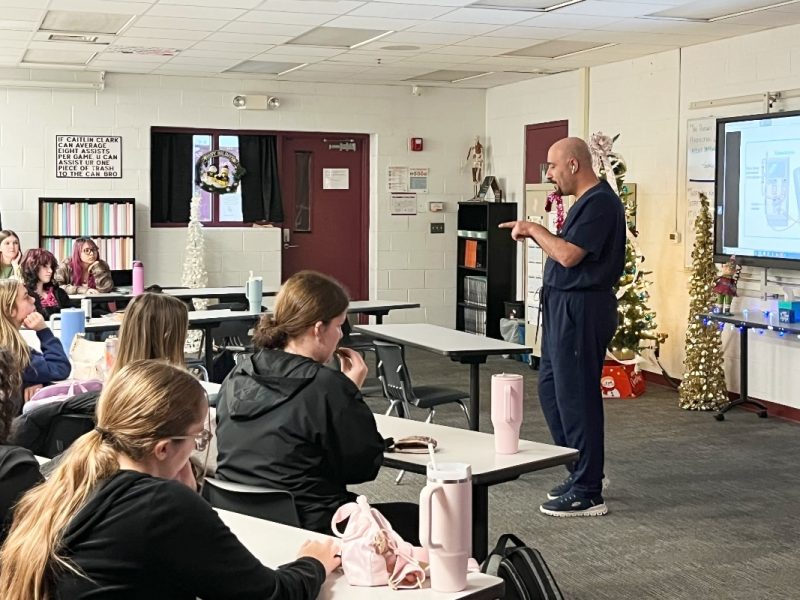
Partner Partner Content “When I grow up.” Inspiring kids to dream big about careers in health care
These collaborations show how growing interest in health care careers can begin early.

Where everyone belongs: Adaptive sports bringing joy and connection to Midland
Lifelines of friendship, empowerment, and belonging for families of all abilities.

Local high schools send 20 Teams to next round of Nickless Innovation Award
Up to $77.5K in scholarships for students, STEM education grants for schools at stake in 13th annual competition.